
What Makes This the Best Lemon Blueberry Focaccia?
Some flavor pairings just work. Lemon and blueberry is one of them — the citrus lifts the berry’s sweetness, the berry rounds out the citrus’s sharp edge, and together they taste like the best part of spring. Put that pairing on a sweet focaccia base, finish it with a glossy lemon glaze, and you get a bread that eats like sunshine: soft, golden, studded with jammy berries, and bright in every bite.
What makes this recipe the best version is that it solves the two problems that sink most lemon blueberry bakes. Problem one: the berries sink. Blueberries are heavy little spheres, and in a soft dough they love to dive straight to the bottom, leaving you with a pale top and a soggy base. This recipe fixes that with a dimple-first technique — you press deep wells into the dough and nestle each berry into its own dimple, where the rising dough cradles it in place. Problem two: the lemon disappears. Lemon flavor bakes off fast, so many “lemon” breads taste like nothing by the time they cool. Here, lemon shows up in three layers — zest kneaded into the dough, juice in a soak brushed on hot from the oven, and zest plus juice in the glaze — so the citrus stays vivid from first bite to last.
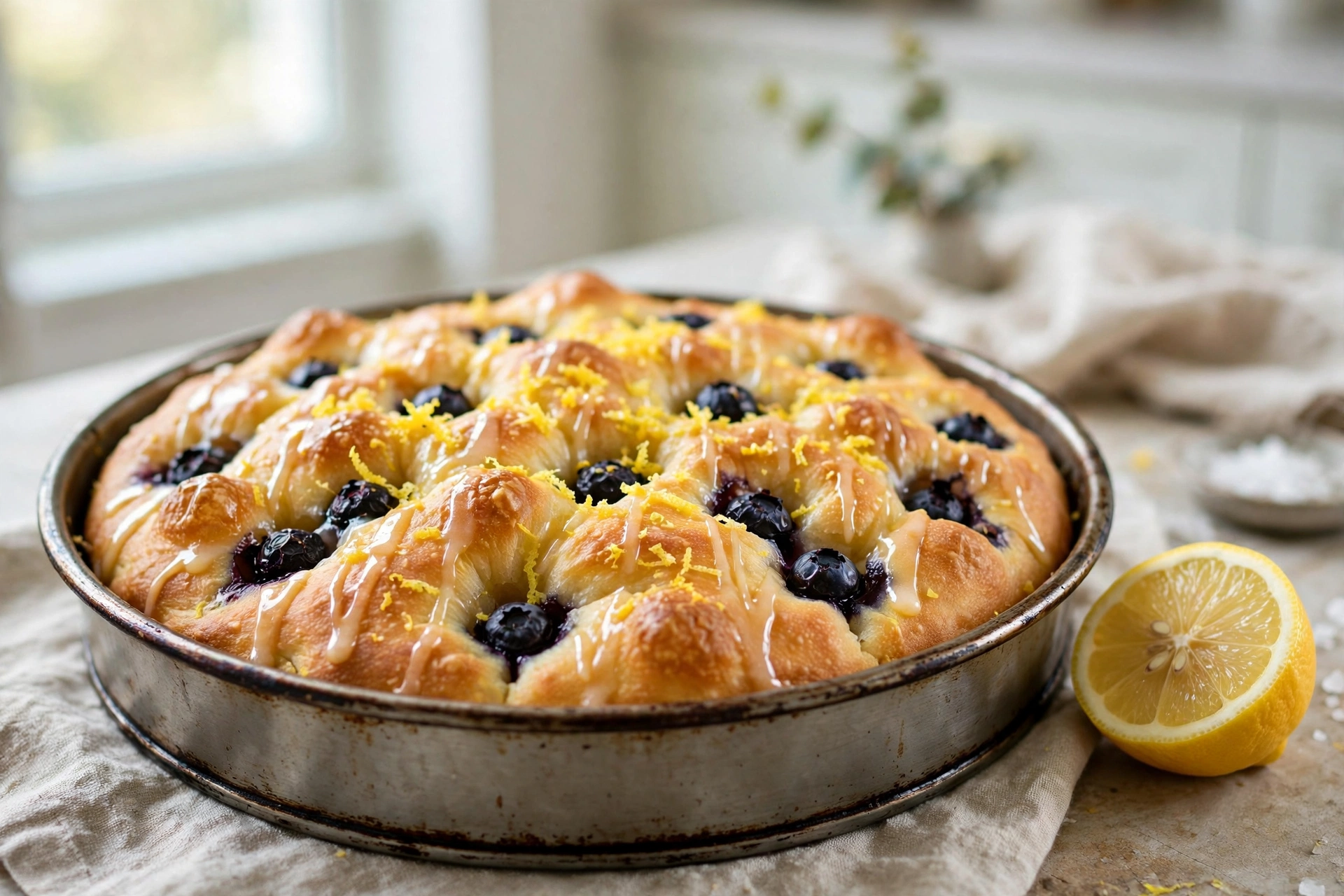
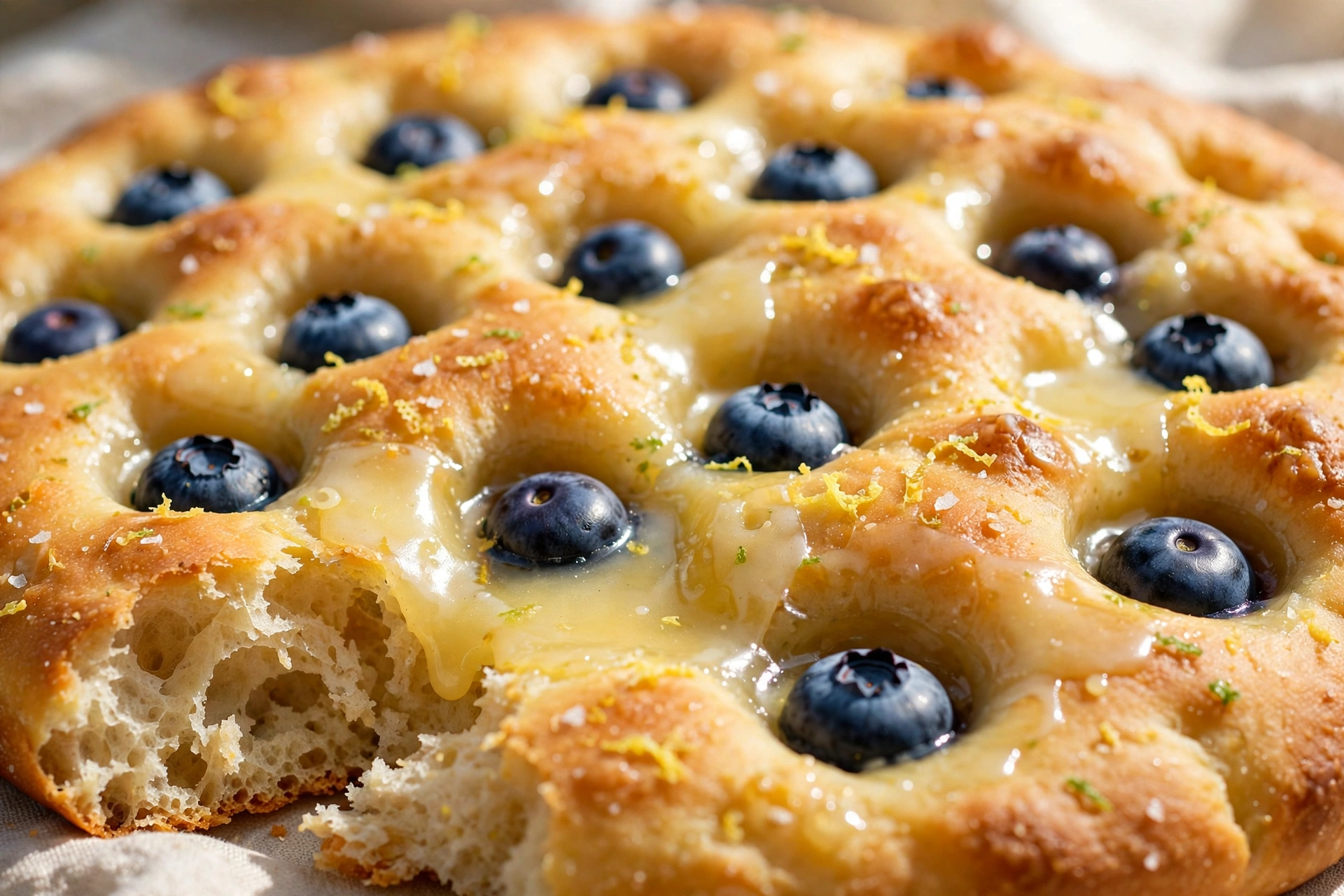
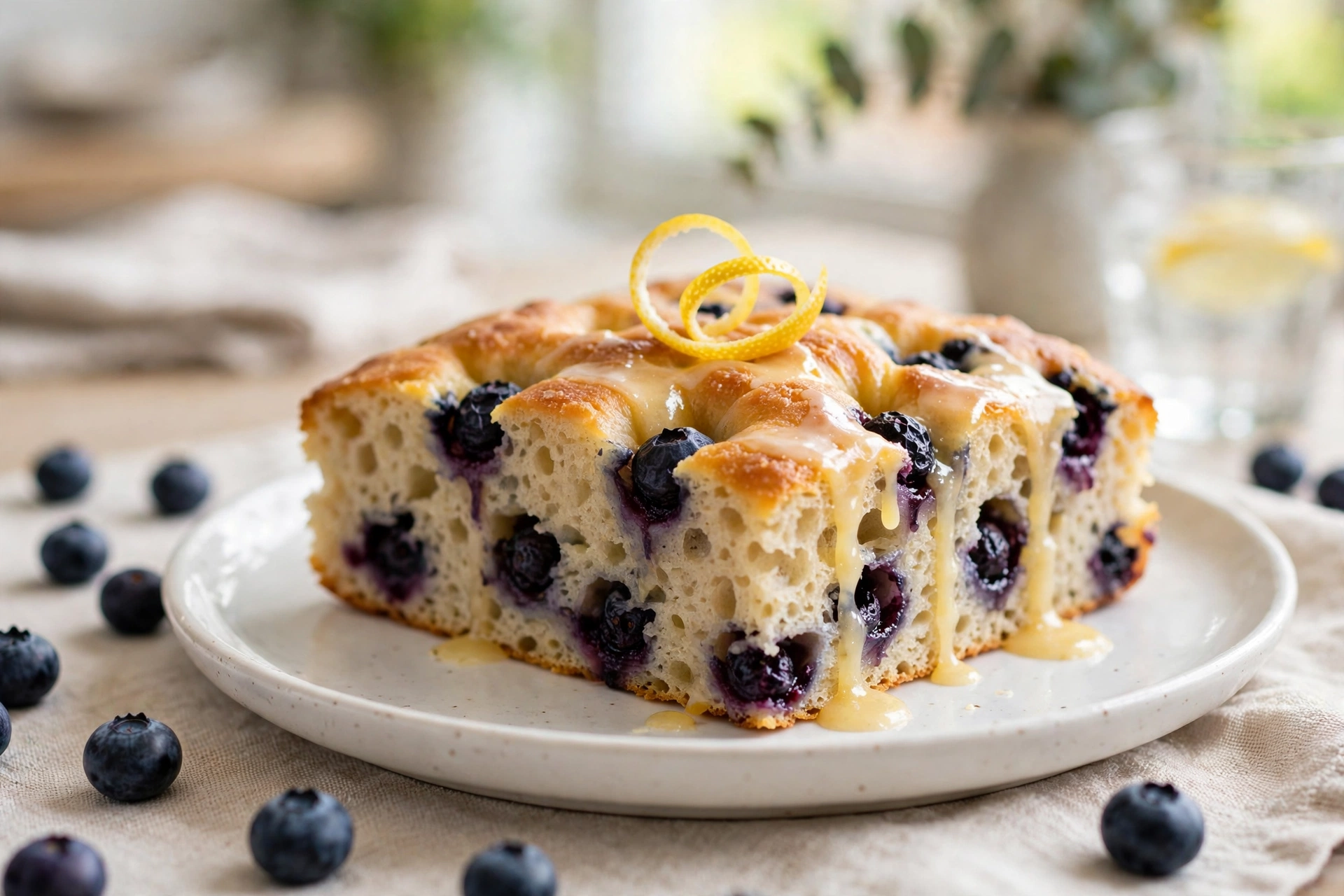
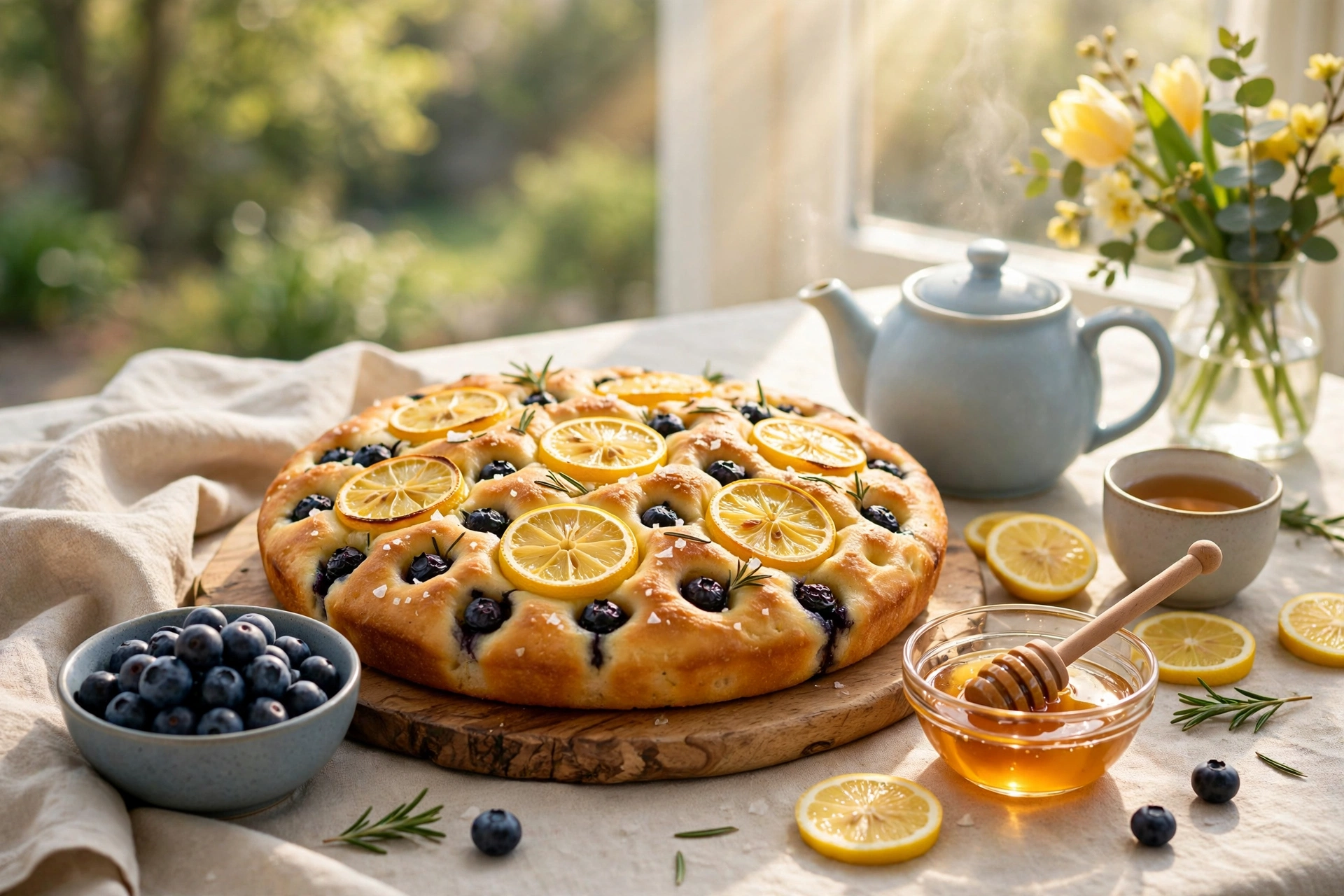
The crumb is everything you want from a sweet focaccia: open and airy with a tender chew, edges crisped golden in olive oil and butter, and a top that crackles lightly under its glaze. The berries burst into jammy pockets. The glaze pools in the dimples and sets into a thin, sweet-tart shell. It looks like a bakery centerpiece and tastes like the reason lemon-blueberry became a classic pairing in the first place.
This guide walks you through the whole thing: the ingredients, the equipment, a detailed step-by-step method with the berry-placement technique, pro tips, the mistakes that ruin this bake, five variations, storage and reheating, serving ideas, and answers to the questions bakers ask most. Let’s make the brightest focaccia in your repertoire.
Why Is Lemon Blueberry Focaccia So Popular?
Lemon-blueberry is one of the most searched flavor combinations in baking, and for good reason — it hits a balance that few pairings manage. Blueberries bring deep, jammy sweetness with a hint of floral flavor. Lemon brings acidity and aroma that keep the sweetness from turning flat. Together they taste fresh rather than heavy, which is exactly what people crave in spring and summer baking.
Focaccia is the ideal vehicle for the pairing. Unlike a muffin or quick bread, where berries sink into batter and lemon fades into the background, focaccia puts everything on display. The berries sit in dimples on the surface, caramelizing at the edges. The lemon glaze goes on top, where you taste it first. Every element stays visible and distinct, and the bread’s chewy crumb gives the juicy fruit something substantial to play against.
There’s a practical appeal, too. Lemon blueberry focaccia covers multiple occasions with one bake. It works as a brunch bread next to coffee, as an afternoon snack with tea, and as a light dessert after dinner — especially with a dollop of whipped cream. It travels well to potlucks and picnics, and it looks impressive with zero decorating skill: the dimpled berries and glossy glaze do all the visual work.
And then there’s the make-ahead factor. The overnight cold ferment means you mix the dough in five minutes one evening and bake it fresh the next morning — warm lemon blueberry focaccia for brunch with almost no morning effort. That kind of payoff-to-effort ratio is why this recipe earns a permanent spot in spring and summer baking rotations.
What Ingredients Do You Need for Lemon Blueberry Focaccia?
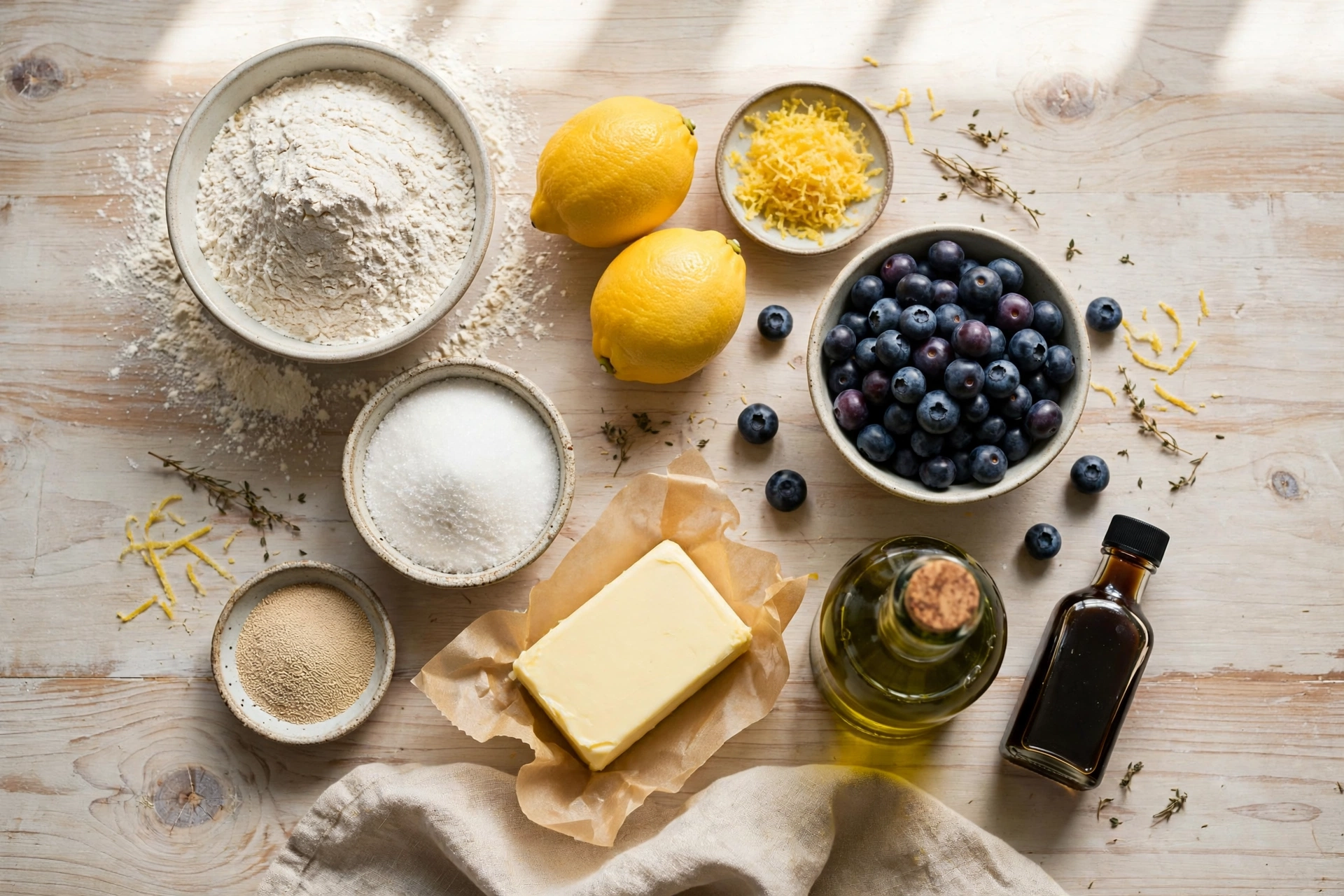
This recipe builds on a classic sweet focaccia dough, with lemon woven through every layer and blueberries placed with intention.
For the dough (one 9×13-inch pan):
- 4 cups (500g) bread flour
- 1/3 cup (65g) granulated sugar
- 2 1/4 teaspoons (1 packet, 7g) instant yeast
- 1 1/2 teaspoons fine sea salt
- Zest of 2 large lemons (about 2 tablespoons)
- 1 3/4 cups (415ml) lukewarm water (about 100°F / 38°C)
- 1/4 cup (60ml) extra-virgin olive oil, plus more for the pan and drizzling
- 3 tablespoons (45g) unsalted butter, melted and slightly cooled
- 1 teaspoon pure vanilla extract
For the blueberry topping:
- 2 cups (about 300g) fresh blueberries, rinsed and patted completely dry
- 2 tablespoons granulated sugar, for sprinkling
- 2 tablespoons unsalted butter, melted
For the lemon soak and glaze:
- 1/4 cup (60ml) fresh lemon juice (from about 2 lemons), divided
- 3 tablespoons honey (for the warm soak)
- 1 cup (120g) powdered sugar
- 1 tablespoon fresh lemon juice (for the glaze)
- 1 teaspoon lemon zest, plus more for garnish
- 1 to 2 teaspoons milk, as needed
A few things matter here. Use fresh lemons, not bottled juice — bottled lemon juice tastes flat and slightly metallic, and you need the zest anyway. Zest the lemons before you juice them; it’s nearly impossible the other way around. When zesting, take only the yellow outer layer; the white pith underneath is bitter and will sour the whole bake.
For blueberries, fresh is strongly preferred. They hold their shape, their skins blister and caramelize, and they stay where you put them. Frozen berries work in a pinch (see the FAQs), but they bleed juice and sink more readily, so fresh is worth seeking out when berries are in season.
The lemon shows up in three waves by design. Zest in the dough perfumes the crumb from the inside. The honey-lemon soak, brushed on while the bread is hot, drives citrus flavor deep into the interior. And the glaze delivers a bright, sweet-tart finish on top. Skip any one layer and the lemon fades; use all three and it sings.
What Equipment Do You Need to Make Lemon Blueberry Focaccia?
The list is short and familiar:
- A 9×13-inch metal baking pan
- A large mixing bowl
- A wooden spoon or dough whisk
- A kitchen scale (strongly recommended for the flour)
- A microplane or fine zester for the lemons
- A small saucepan or microwave-safe bowl (for warming the soak)
- A whisk and a small bowl (for the glaze)
- Measuring cups and spoons
- Plastic wrap or a damp kitchen towel
- A wire cooling rack
- A pastry brush (for the lemon soak)
The microplane is the one tool worth calling out. A box grater’s zesting side tears the peel into thick strips that taste bitter; a microplane shaves off fine, aromatic zest that melts into the dough. If you bake with citrus regularly, it earns its drawer space many times over.
How Do You Make Lemon Blueberry Focaccia Step by Step?
Read the berry-placement steps carefully — they are the heart of this recipe and the difference between berries on top and berries lost at the bottom.
- Mix the dough. In a large bowl, whisk together the flour, sugar, instant yeast, salt, and lemon zest. Rub the zest into the dry ingredients with your fingertips for 30 seconds — this releases the citrus oils and perfumes the whole bowl. In a jug, combine the lukewarm water, olive oil, melted butter, and vanilla. Pour into the dry ingredients and stir until no dry flour remains. The dough will be shaggy, sticky, and rough. Do not add flour.
- Rest and fold. Cover and rest 30 minutes at room temperature. With wet hands, perform four stretch-and-folds (stretch one side up and fold over the center, rotate, repeat). Cover, rest 30 minutes, and fold once more. The dough should already feel smoother and more elastic.
- Cold ferment overnight. Cover tightly and refrigerate 12 to 18 hours. The slow ferment builds flavor and makes the dough silky and easy to handle. It should roughly double and show bubbles across the surface.
- Pan and proof. Oil a 9×13-inch pan with 2 tablespoons of olive oil. Gently tip in the cold dough and stretch it toward the corners with oiled fingers, resting 15 minutes between stretches if it springs back. Cover and proof at warm room temperature for 1 1/2 to 2 hours, until puffy, doubled, and jiggly when you nudge the pan.
- Dimple deeply. Preheat the oven to 425°F (220°C), rack in the lower third. Drizzle the dough with 1 tablespoon of olive oil and the melted butter. Press your oiled fingers straight down to the pan in a tight grid, about 1 inch apart. Go deep — these wells are what hold the berries in place.
- Place the blueberries so they don’t sink. This is the key move. Press one or two blueberries into each dimple, pushing them about halfway into the dough — not just resting on top, not buried to the bottom. The dimple walls cradle each berry as the dough rises around it in the oven’s heat, locking it in place. Work in a grid so every slice gets berries. Sprinkle the 2 tablespoons of sugar evenly over the top.
- Bake. Bake 22 to 28 minutes, until deeply golden with caramelized edges and the berries are jammy and just starting to burst. Tent with foil if the top browns too fast. The sugar and fruit juices mean this browns quicker than savory focaccia — start checking at 20 minutes.
- Brush with the lemon-honey soak. While the focaccia bakes, warm the 1/4 cup lemon juice with the honey until the honey dissolves. The moment the bread comes out of the oven, brush this soak generously over the hot surface. It will sizzle and absorb, driving lemon flavor deep into the crumb while the bread is at its most receptive.
- Cool, then glaze. Cool in the pan 10 minutes, then transfer to a wire rack. Wait until the bread is just warm — not hot — before glazing. Whisk the powdered sugar with 1 tablespoon lemon juice, 1 teaspoon zest, and enough milk to make a thick but pourable glaze. Drizzle it over the focaccia in zigzags, letting it pool in the dimples. Glazing a hot loaf melts the glaze into invisibility; glazing a warm loaf lets it set into a glossy, sweet-tart shell. Finish with extra lemon zest.
- Rest before slicing. Wait at least 20 to 30 minutes after glazing before cutting, so the glaze sets and the crumb finishes. Then slice and serve.
What Are the Pro Tips for Perfect Lemon Blueberry Focaccia?
Dry the berries completely. Water is the enemy of a crisp top. After rinsing, spread the blueberries on a clean kitchen towel and pat them dry, then let them air-dry for 10 minutes. Even a little surface water turns to steam in the oven and loosens the berries from their dimples.
Toss the berries in a spoonful of flour. This old baker’s trick gives the berries a light coating that grips the dough and slows their descent. Use just 1 teaspoon of flour for 2 cups of berries — toss gently in a bowl before placing. It also thickens the juices they release, turning them jammy instead of watery.
Zest with a light hand. Only the yellow part. The moment you see white pith, move to a new spot on the lemon. Pith is bitter, and bitterness is the fastest way to ruin an otherwise perfect lemon bake. Two large lemons give you plenty of zest; don’t try to squeeze every last bit from one.
Layer the lemon in three waves. Zest in the dough, the honey-lemon soak on the hot loaf, and the glaze on the warm loaf. Each wave hits differently — aroma in the crumb, brightness soaked through, and a sweet-tart finish on top. This triple-layering is what separates a focaccia that whispers lemon from one that sings it.
Glaze at the right temperature. Too hot and the glaze melts into a transparent film; too cold and it sits thick and chalky. Aim for “warm to the touch” — about 15 to 20 minutes out of the oven. The glaze should flow into the dimples and set with a soft sheen.
Don’t skip the sugar sprinkle. Those 2 tablespoons of sugar over the berries aren’t just sweetness — they draw out the berry juices slightly and help them caramelize at the edges, creating jammy, blistered berries instead of plain baked ones.
Taste your lemons. Lemons vary wildly in acidity. If yours are mild, add an extra teaspoon of zest to the glaze. If they’re aggressively tart, pull back the soak slightly. Baking with citrus is a conversation, not a formula.
What Common Mistakes Should You Avoid?
- Letting the berries sink. Berries scattered on top of un-dimpled dough slide and sink. Berries buried deep drown at the bottom. The fix is the dimple-and-nest method: deep wells, berries pressed halfway in, dough rising up around them. Shallow dimpling is the usual culprit when berries still sink — go deeper.
- Using wet berries. Rinsed-but-not-dried berries steam in the oven, loosen from the dough, and bleed watery juice across the top. The surface never crisps, and the berries roll around instead of caramelizing. Pat them thoroughly dry and give them the flour toss.
- Adding all the lemon at once. Dumping extra juice into the dough to boost flavor backfires: the acid tightens gluten and the liquid throws off hydration. The result is a dense loaf that still doesn’t taste lemony, because much of the flavor bakes off. Layer it instead — zest in the dough, soak after baking, glaze on top.
- Glazing a piping-hot loaf. Fresh from the oven, the bread’s surface is well over 200°F. Glaze poured on now melts straight into the crust and vanishes, leaving you with a sticky top and no visible finish. Wait until the loaf is warm, not hot, and the glaze will set into the glossy shell you’re picturing.
- Overloading the berries. Two cups is the sweet spot for a 9×13-inch pan. More than that and the berries pile up, steam each other instead of roasting, and weigh down the dough so it can’t rise fully. Every berry should touch dough, not sit on other berries.
- Under-baking out of fear. The golden-brown top with caramelized berry edges looks darker than beginners expect, and the instinct is to pull it early. An under-baked focaccia has a gummy layer just under the top and berries that taste raw rather than jammy. Trust the color: deep golden with bubbling, blistered berries means done. A skewer in the center should come out without wet dough.
What Are the Best Lemon Blueberry Focaccia Variations?
Same master method, five new directions. Each variation keeps the dimple-and-nest berry technique and the triple-lemon layering, with twists on top.
- How do you make lemon blueberry focaccia with cream cheese swirl? Beat 8 ounces of softened cream cheese with 1/4 cup sugar, 1 egg yolk, and 1 teaspoon vanilla until smooth. After dimpling, dollop spoonfuls over the dough and swirl through the wells with a knife, then nestle the blueberries in around it. Bake as directed and glaze. The tangy cream cheese ribbons turn almost cheesecake-like — this is the brunch version people ask about for weeks.
- How do you make a lemon-blueberry streusel focaccia? Make a quick streusel: 1/2 cup flour, 1/3 cup sugar, 1/2 teaspoon cinnamon, 4 tablespoons cold butter rubbed to crumbs, plus 1 teaspoon lemon zest stirred in. Place the berries in the dimples, then blanket the top with streusel. Bake 25 to 30 minutes. The streusel crisps into a buttery, lemon-scented lid over jammy berries — like a coffee cake and a focaccia had a very good idea together.
- How do you make lemon blueberry focaccia with a mascarpone topping? Bake the focaccia with berries and the lemon soak but skip the powdered-sugar glaze. Whip 8 ounces mascarpone with 3 tablespoons honey and 1 teaspoon lemon zest until fluffy. Serve thick slices with a generous quenelle of mascarpone and extra fresh blueberries. Lighter and less sweet than the glazed version, and the cool cream against the warm bread is superb for summer entertaining.
- How do you make a mixed-berry lemon focaccia? Swap half the blueberries for raspberries and blackberries. Because raspberries are more fragile, press them in very gently and only halfway — they break down faster. Add the lemon soak and glaze as usual. The mix of berries gives you sweet, tart, and floral notes in every bite, and the color contrast is stunning. Reduce the sugar sprinkle slightly since raspberries bring more tartness.
- How do you make lemon blueberry focaccia with an almond twist? Add 1/2 teaspoon almond extract to the dough along with the vanilla, and sprinkle 1/3 cup sliced almonds over the berries before baking. The almonds toast to a deep golden crunch that plays beautifully against the soft berries. Finish with the lemon glaze and an extra scatter of zest. Lemon, blueberry, and almond is a bakery-case classic for a reason — nutty, bright, and deeply satisfying.
How Do You Store and Reheat Lemon Blueberry Focaccia?
Room temperature (1 day): Because of the fresh fruit and glaze, this focaccia is best the day it’s baked. Once completely cool, cover tightly with plastic wrap or store in an airtight container at room temperature and eat within 24 hours for the crispest top and brightest flavor.
Refrigerator (up to 4 days): For longer keeping, refrigerate in an airtight container for up to 4 days. The glaze will soften and the berries will continue to release a little juice — that’s normal. Always reheat before serving; cold focaccia is a shadow of itself.
Freezer (up to 3 months): This focaccia freezes well, with one caveat: freeze it unglazed if you can. Cool the baked loaf completely, wrap slices tightly in plastic wrap, and tuck into a freezer bag with the air pressed out. Thaw at room temperature for about an hour, reheat, and then glaze fresh. If it’s already glazed, it still freezes fine — the glaze just softens a bit on thawing.
Reheating: Warm in a 350°F (175°C) oven for 8 to 10 minutes (12 to 15 from frozen) until the edges re-crisp and the berries warm through. A toaster oven works for single slices. Skip the microwave — it makes the crust chewy and the glaze gummy. If the top looks dull after storage, brush with a little warm honey before reheating to bring back the shine, or add a fresh drizzle of glaze after warming.
How Should You Serve Lemon Blueberry Focaccia?
This is a born brunch bread. Serve thick slices slightly warm with coffee or tea, and let the lemon glaze do the talking. It needs nothing else on the plate, though a bowl of extra fresh berries alongside never hurts.
For a proper brunch spread, pair it with a savory counterpoint — a simple egg bake, crispy bacon, or a cheese board. The bright, sweet-tart bread cuts through rich, salty foods beautifully and keeps the whole table feeling balanced rather than heavy.
As dessert, warm a slice and add a scoop of vanilla ice cream or a spoonful of lightly sweetened whipped cream. A few fresh blueberries and a twist of lemon zest on top make it dinner-party ready in seconds. It also works beautifully next to a lemon sorbet for a double-citrus finish.
For afternoon tea, cut the focaccia into smaller squares and serve with clotted cream or mascarpone. For picnics and potlucks, bake, cool, glaze, slice into squares, and transport in the pan — it holds up well at room temperature for several hours.
One more idea: turn day-old slices into the best French toast you’ve had in a while. The lemon-blueberry bread soaks up custard beautifully, and the berries caramelize in the pan. Serve with maple syrup and extra berries.
Lemon Blueberry Focaccia FAQs
How do I keep blueberries from sinking in focaccia?
Use the dimple-and-nest method: press deep wells into the dough (fingers all the way to the pan), then press each berry about halfway into a dimple. As the dough rises in the oven, it swells up around the berries and locks them in. Also pat the berries completely dry, toss them in a teaspoon of flour, and don’t overload — 2 cups per 9×13-inch pan is the sweet spot.
Can I use frozen blueberries?
Yes, with adjustments. Thaw them completely, drain thoroughly, and pat very dry — then pat again. Toss in flour as usual. Expect more juice bleeding and a slightly softer top; the par-bake trick helps a lot here (bake the dimpled dough 10 minutes before adding berries). The flavor will still be excellent, but fresh berries give the best texture and appearance.
Why doesn’t my focaccia taste lemony enough?
Lemon flavor bakes off, so a single addition rarely survives the oven. This recipe layers it three ways: zest rubbed into the dough, a honey-lemon soak brushed on hot from the oven, and zest plus juice in the glaze. If yours still tastes faint, your lemons may be mild — add extra zest to the glaze, or brush on a second round of soak. Never just add more juice to the dough; the acid will toughen the crumb.
Can I make this with Meyer lemons?
Absolutely, and it’s lovely. Meyer lemons are sweeter and more floral than regular lemons, so the result is gentler and more aromatic. Use the same quantities, but taste as you go — you may want a touch less honey in the soak since Meyers bring their own sweetness. They’re seasonal (roughly winter through early spring), so treat it as a special-occasion version.
How do I get a smooth, glossy glaze?
Three things: sift the powdered sugar to remove lumps, add the liquid a teaspoon at a time until the glaze ribbons off the whisk, and glaze the bread while it’s warm — not hot, not cold. If the glaze is too thick, it sits chalky; too thin, and it slides off. You’re aiming for the consistency of thick honey. A warm loaf helps it flow into the dimples and set with a sheen.
Can I make the dough ahead of time?
Yes — the recipe is built for it. The dough cold-ferments in the refrigerator for 12 to 18 hours, and you can stretch that to 24 hours if needed. You can also freeze the dough after the folds: wrap tightly and freeze up to a month, then thaw overnight in the fridge before panning and proofing. Baked focaccia also freezes well (see storage above).
Why did my glaze disappear into the bread?
You glazed too hot. On a loaf fresh from the oven, the surface is hot enough to melt powdered-sugar glaze into a thin, invisible film. Wait until the bread is warm to the touch — about 15 to 20 minutes of cooling — before glazing. If it happened already, just make a second batch of glaze and apply it once the bread cools further.
Can I halve this recipe?
Yes. Use an 8×8-inch pan, halve all ingredients exactly (a scale helps), and start checking for doneness around 18 minutes. The dimple-and-nest technique and all three lemon layers stay the same — just with fewer dimples to fill. It also doubles cleanly across two 9×13-inch pans.
What’s the best way to zest a lemon?
Use a microplane, hold the lemon firmly, and drag it across the zester with light pressure, rotating to a fresh patch of peel as soon as you see white pith. Zest directly over your bowl so the aromatic oils land in the mix. One large lemon yields roughly 1 tablespoon of zest. Zest before juicing — trying to zest a squeezed lemon half is an exercise in frustration.
Final Thoughts
Lemon blueberry focaccia is proof that a few careful techniques can elevate a simple dough into something memorable. The dimple-and-nest method keeps every berry exactly where it belongs. The triple-layer lemon approach — zest in the dough, soak on the hot loaf, glaze on the warm one — keeps the citrus bright from crust to crumb. And the overnight ferment does the quiet work of building deep, complex flavor while you sleep.
Make it for a spring brunch, a summer picnic, or just because Tuesday needed brightening. Start with the classic glazed version to learn the method, then explore: the cream cheese swirl for indulgence, the streusel for coffee-cake lovers, the mascarpone topping for effortless elegance.
However you finish it, remember the fundamentals that make this recipe work: dry berries, deep dimples, layered lemon, and a glaze applied warm, never hot. Get those right, and every slice will taste like the best of the season.
If this lemon-blueberry bake has you hooked on dessert-style focaccia, try our cinnamon focaccia for a warm, sweet-spiced twist on the same pillowy base. And for the full rundown on turning focaccia into a bakery-worthy dessert, our complete guide to sweet focaccia bread has you covered.