How Do You Make the Best Cornbread Stuffing for Thanksgiving?
SEO Title: Cornbread Stuffing Recipe: Southern-Style & Golden
Meta Description: This classic cornbread stuffing recipe is buttery, golden, and full of savory herbs. Learn how to make Southern-style dressing step by step.
Some Thanksgiving dishes are negotiable. Cornbread stuffing is not. In my family, the turkey could be perfect and the pie could be flawless, but if the cornbread stuffing did not show up golden and steaming, somebody was going to complain. Loudly.
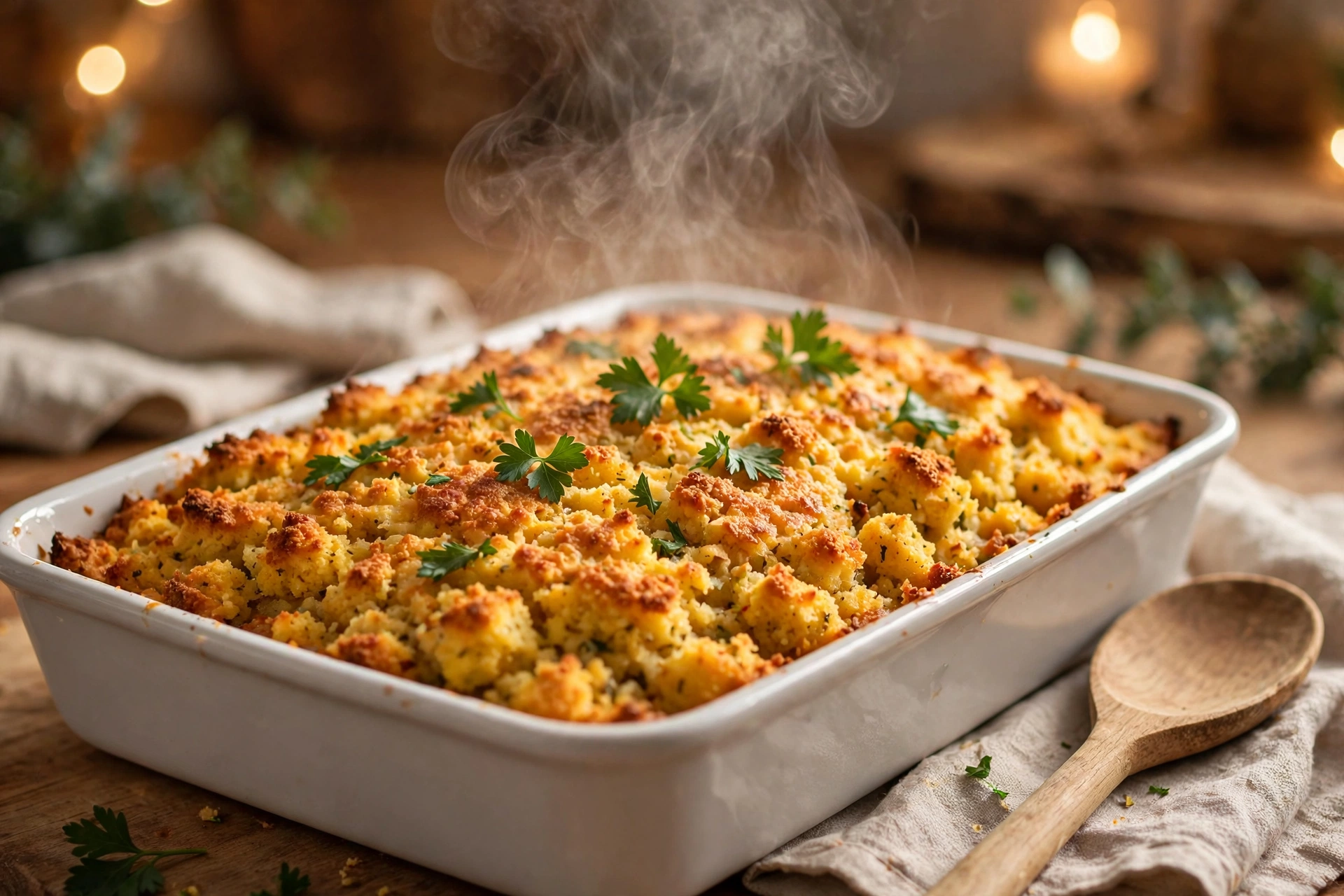
This cornbread stuffing is the Southern-style dressing I grew up on, refined through years of holiday cooking. It starts with real cornbread — baked, cooled, and crumbled — then gets loaded with sweet Italian sausage, softened celery and onion, and a heavy hand of sage, thyme, and parsley. Chicken broth soaks through every crumb, and the whole thing bakes until the top turns deeply golden and crisp while the center stays soft and custardy.
What makes this recipe the best is balance. The cornbread brings a gentle sweetness and a tender crumb that regular bread stuffing cannot match. The sausage adds savory depth. The vegetables keep it from feeling heavy. And the bake time is tuned so you get those irresistible crispy edges without drying out the middle. Make it once, and it will earn a permanent spot on your holiday table.
What Is Cornbread Stuffing and Why Is It So Popular?
Cornbread stuffing — called “dressing” across much of the South, since it is baked in a dish rather than inside the bird — is a savory side dish made from crumbled cornbread mixed with aromatics, herbs, broth, and often sausage or other meats. It is the backbone of the Southern Thanksgiving plate.
Its popularity comes down to texture and flavor. Cornbread has a finer, more tender crumb than sandwich bread, so the finished stuffing eats almost like a savory bread pudding: crisp on top, soft underneath. The cornmeal itself adds a subtle sweetness that plays beautifully against salty sausage and earthy sage. Where white-bread stuffing can taste bland or gummy, cornbread stuffing tastes like something.
The dish also carries deep roots. Cornbread was a staple grain across the South long before wheat bread was common, so holiday dressing grew up around it. Families pass their recipes down like heirlooms, each one slightly different. This version honors that tradition while fixing the two problems that plague most recipes: dryness and blandness.
What Ingredients Do You Need for Cornbread Stuffing?
This recipe uses one 9×13 pan of homemade cornbread as the base. You can bake it up to two days ahead — slightly stale cornbread actually absorbs broth better. If you are in a hurry, a good bakery cornbread works too, but skip the super-sweet cake-like mixes.
For the cornbread:
- 1 1/2 cups yellow cornmeal — stone-ground if you can find it
- 1 cup all-purpose flour
- 1 tablespoon baking powder
- 1 teaspoon fine sea salt
- 1/4 cup granulated sugar — just enough for balance, not sweetness
- 1 1/4 cups whole milk or buttermilk
- 2 large eggs — room temperature
- 1/2 cup unsalted butter — melted, plus more for the pan
For the stuffing:
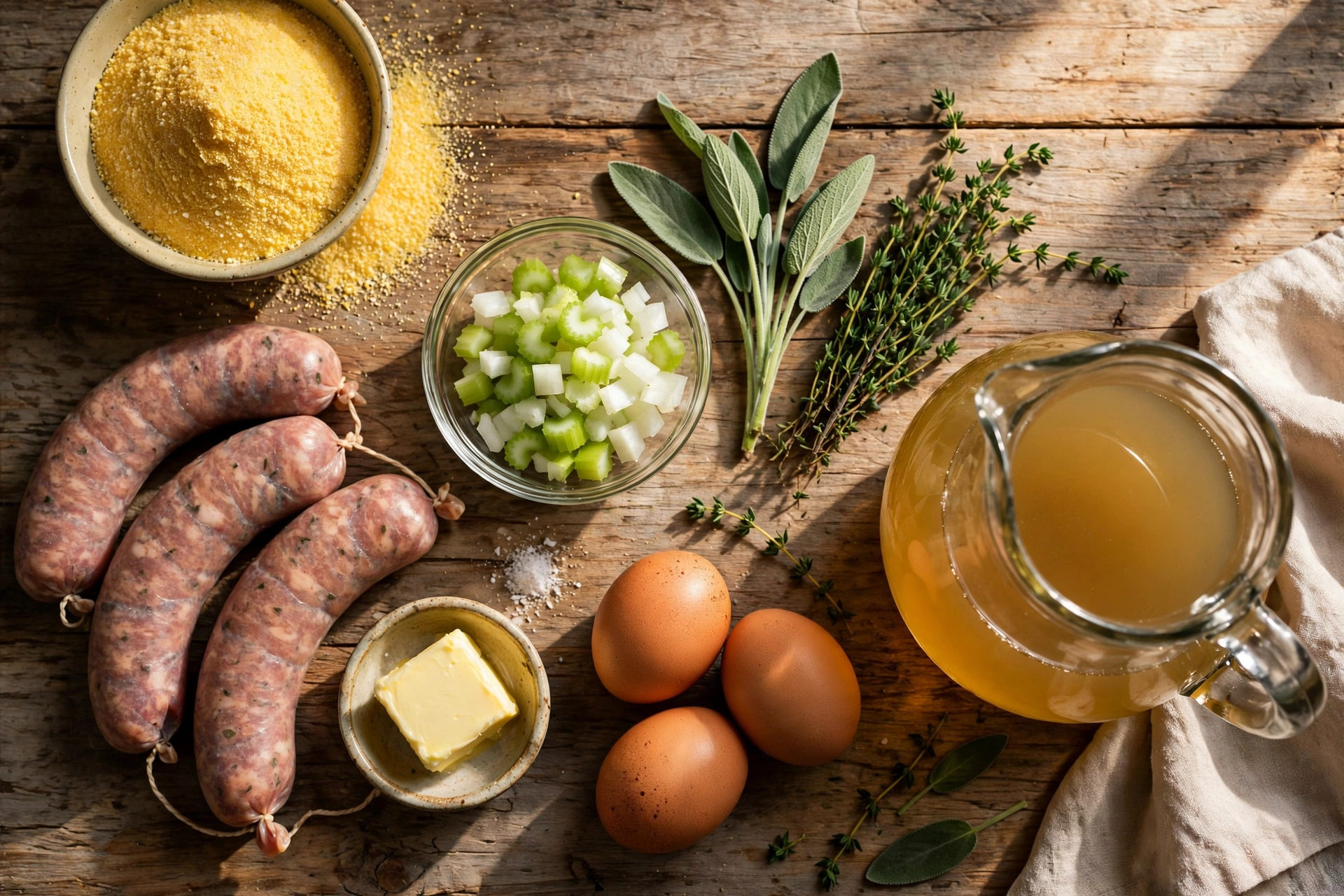
- 1 pound sweet Italian sausage — casings removed (or use bulk sausage)
- 4 tablespoons unsalted butter — plus more for greasing the dish
- 2 medium yellow onions — diced (about 2 cups)
- 4 celery stalks — diced (about 1 1/2 cups)
- 3 cloves garlic — minced
- 2 tablespoons fresh sage — finely chopped (or 2 teaspoons dried)
- 1 tablespoon fresh thyme leaves (or 1 teaspoon dried)
- 1/4 cup fresh parsley — chopped
- 1 teaspoon kosher salt — plus more to taste
- 1/2 teaspoon freshly ground black pepper
- 3 to 4 cups low-sodium chicken broth — warmed
- 2 large eggs — beaten, to bind
A note on the sausage: sweet Italian sausage is the classic choice, but hot Italian sausage gives the stuffing a welcome kick. You can also leave the sausage out entirely for a vegetarian version — just add an extra tablespoon of butter and a splash more broth.
What Equipment Do You Need to Make Cornbread Stuffing?
Nothing specialized, but a big mixing bowl matters more than you think. Cornbread cubes are bulky, and you need room to toss them without crushing them into paste.
- A 9×13-inch baking dish — for the cornbread and again for the stuffing
- A large skillet — for browning the sausage and softening the vegetables
- A very large mixing bowl — the biggest one you own
- A wooden spoon or silicone spatula — for gentle tossing
- A sharp knife and cutting board — for the vegetables and herbs
- Measuring cups and spoons
- Aluminum foil — for covering during the first part of baking
How Do You Make Cornbread Stuffing Step by Step?
This is a two-stage recipe: bake the cornbread first, then assemble and bake the stuffing. Do the cornbread a day ahead if you can — it makes Thanksgiving Day much calmer.
Step 1: Bake the cornbread. Heat the oven to 400°F. Butter a 9×13-inch baking dish. Whisk the cornmeal, flour, baking powder, salt, and sugar in a large bowl. In a second bowl, whisk the milk, eggs, and melted butter. Pour the wet ingredients into the dry and stir just until combined — a few lumps are fine. Spread into the dish and bake 20 to 25 minutes, until golden and a toothpick comes out clean.
Step 2: Cool and crumble. Let the cornbread cool completely in the dish, at least 1 hour. Then crumble it into rough 1-inch chunks with your hands. Spread the chunks on a sheet pan and let them sit out overnight, or dry them in a 250°F oven for 30 minutes. Dry cubes soak up broth without turning to mush.
Step 3: Brown the sausage. Set a large skillet over medium-high heat. Add the sausage, breaking it into small crumbles with your spoon. Cook 8 to 10 minutes until deeply browned and cooked through. Scoop the sausage out with a slotted spoon and set it aside, leaving the drippings in the pan.
Step 4: Soften the vegetables. Reduce the heat to medium. Add the butter to the sausage drippings, then the onion and celery. Cook 8 to 10 minutes, stirring often, until the vegetables are soft and the onion turns translucent. Stir in the garlic, sage, and thyme and cook 1 minute more, until fragrant.
Step 5: Combine everything. Tip the dried cornbread chunks into your biggest mixing bowl. Add the sausage and the vegetable mixture, scraping in every bit of the buttery drippings. Sprinkle over the parsley, salt, and pepper. Toss gently with your hands or a spatula until everything is evenly distributed.
Step 6: Add broth and eggs. Pour 3 cups of the warm broth over the mixture and toss again. Let it sit 5 minutes so the cornbread drinks it up. The mixture should look moist but not soupy — every cube damp, with a little liquid pooling at the bottom of the bowl. Add the fourth cup of broth if it looks dry. Drizzle in the beaten eggs and toss once more.
Step 7: Bake covered, then uncovered. Heat the oven to 375°F. Butter the 9×13 dish and pack the stuffing in loosely — do not press it down hard. Cover tightly with foil and bake 30 minutes. Remove the foil and bake 20 to 25 minutes more, until the top is deeply golden and crisp at the edges and the center is set.
Step 8: Rest and serve. Let the stuffing rest 10 minutes before scooping. This firms up the center so it holds together on the plate. Serve hot, with extra gravy on the side for anyone who wants it.
What Are the Best Pro Tips for Perfect Cornbread Stuffing?
- Dry your cornbread well. This is the single biggest factor in good texture. Fresh, soft cornbread turns gummy in the stuffing. Overnight air-drying or a low oven gives you cubes that hold their shape while soaking up flavor.
- Use warm broth. Warm broth absorbs faster and more evenly than cold broth. Heat it in a saucepan or the microwave before pouring it over the cubes.
- Do not overmix. Toss gently and stop as soon as everything is combined. Aggressive stirring breaks the cubes into paste and ruins the texture.
- Taste before baking. Fry a spoonful of the mixture in a small pan and taste it. This is your only chance to adjust the salt and herbs. The raw eggs make tasting the raw mix unsafe, so the fry test is the way.
- Pack it loosely. Stuffing needs air pockets to bake up fluffy. Pressing it down hard makes a dense, heavy brick. Spoon it in and level the top lightly.
- Butter the dish generously. A well-buttered dish gives you those crispy, caramelized edges everyone fights over. Do not be shy with it.
- Make it ahead smartly. Assemble the stuffing (without baking) up to a day ahead, cover, and refrigerate. Add 10 extra minutes to the covered bake time when baking from cold.
What Are the Most Common Cornbread Stuffing Mistakes to Avoid?
Mistake 1: Using sweet, cake-like cornbread. Those sugary boxed mixes bake up like dessert. In stuffing, all that sugar throws the savory balance off and the fine crumb dissolves into mush. Use a savory, sturdy cornbread — the recipe above is built for this.
Mistake 2: Adding too much broth. Drowning the cubes makes stuffing soupy, and no amount of baking fully fixes it. Add broth gradually. The mix should be thoroughly moist with a little liquid at the bottom of the bowl, never swimming.
Mistake 3: Skipping the covered bake. Baking uncovered the whole time dries out the interior before the top crisps. The foil cover steams the center first; the uncovered finish crisps the top. Both stages matter.
Mistake 4: Chopping the vegetables too big. Large chunks of raw-tasting celery ruin the texture. Dice the onion and celery small — about 1/4 inch — so they soften fully and disappear into the stuffing.
Mistake 5: Forgetting to season in layers. Salt the vegetables as they cook, season the bread mixture, and taste at the end. Stuffing made from unsalted cornbread and low-sodium broth needs deliberate seasoning at every stage or it tastes flat.
Mistake 6: Baking it too far ahead. Stuffing is at its peak fresh from the oven. Baking it hours early and holding it warm dries it out and softens the crispy top. If you must bake ahead, reheat covered with a splash of broth.
What Are the Best Cornbread Stuffing Variations to Try?
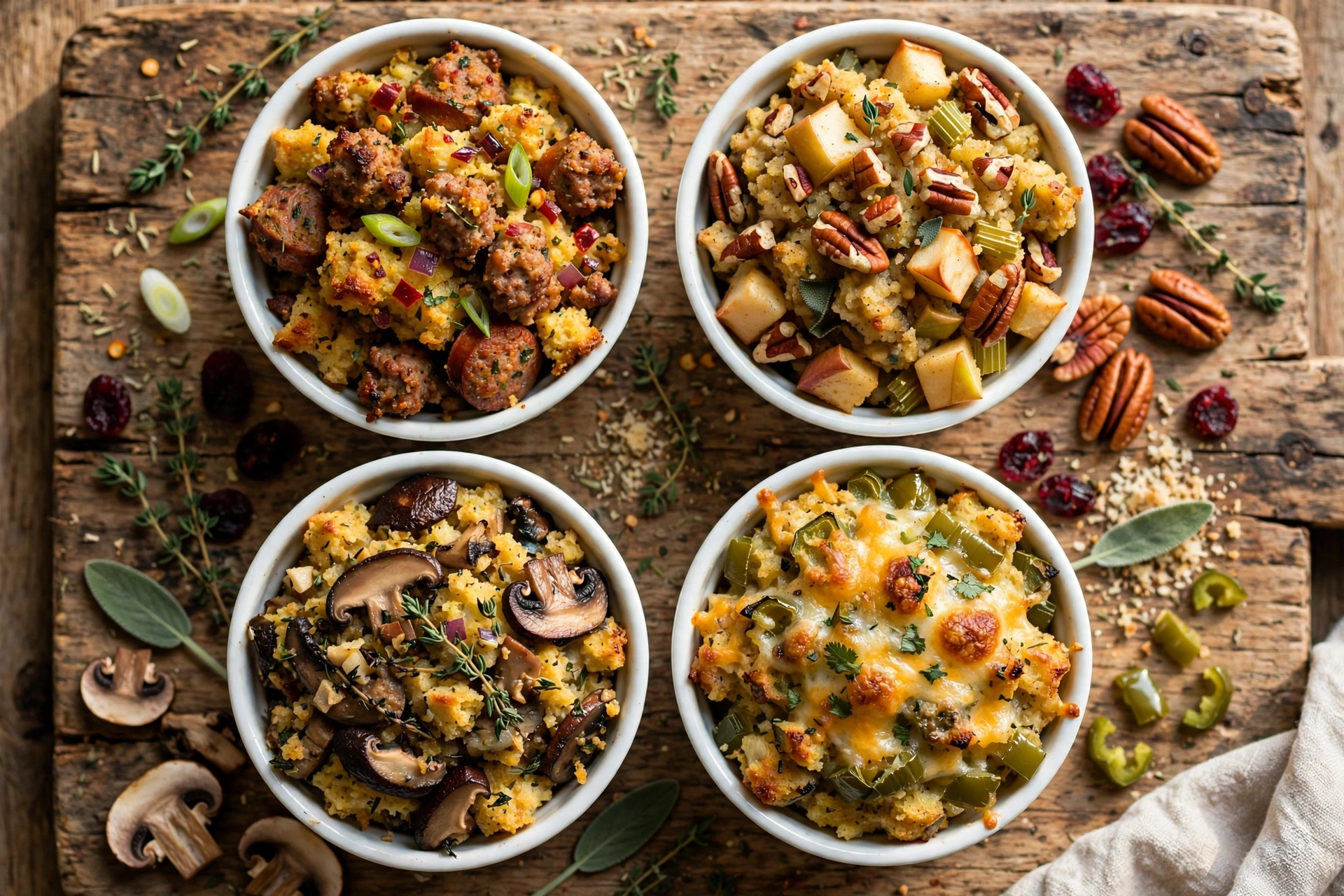
The base recipe is a canvas. These five variations each change the personality of the dish while keeping the method exactly the same.
Variation 1: Classic Vegetarian Cornbread Stuffing. Skip the sausage entirely. Add 8 ounces of sliced cremini mushrooms, browned hard in butter until deeply golden, plus an extra tablespoon of butter and 1/2 cup more vegetable broth in place of chicken broth. The mushrooms bring the savory depth the sausage would have added.
Variation 2: Spicy Andouille Cornbread Stuffing. Swap the Italian sausage for andouille and add 1 diced poblano pepper with the onions. Stir in 1 teaspoon of smoked paprika. The result is smoky and bold with real heat — a Louisiana-leaning dressing that wakes up the whole plate.
Variation 3: Apple and Pecan Cornbread Stuffing. Brown the sausage as usual, then add 2 diced Honeycrisp apples and 1 cup of toasted chopped pecans to the mix. Reduce the sage slightly and add 1/2 teaspoon of cinnamon. Sweet, crunchy, and nutty — the apples stay pleasantly firm against the soft crumbs.
Variation 4: Oyster Cornbread Stuffing. A Lowcountry classic. Leave out the sausage and fold in 1 pint of shucked oysters (with their liquor) plus 4 chopped scallions at the very end, just before the broth. Bake as directed. The oysters turn plump and briny, and the liquor seasons the whole dish like the sea.
Variation 5: Southwestern Cornbread Stuffing. Replace the Italian sausage with chorizo, swap the sage and thyme for 2 tablespoons of chopped cilantro and 2 teaspoons of ground cumin, and add a 4-ounce can of diced green chiles with the vegetables. Top with shredded pepper jack for the last 10 minutes of baking.
How Do You Store and Reheat Cornbread Stuffing?
Refrigerating: Cool leftover stuffing within 2 hours of baking. Pack it into airtight containers and refrigerate for up to 4 days. The flavors actually meld overnight, so day-two stuffing can taste even better.
Freezing: Cornbread stuffing freezes well. Portion it into freezer-safe containers or bags, press out the air, and freeze for up to 3 months. Thaw overnight in the refrigerator before reheating.
Reheating in the oven (best method): Place the stuffing in a baking dish, drizzle 2 to 3 tablespoons of broth over the top, cover with foil, and warm at 350°F for 20 to 25 minutes. Remove the foil for the last 5 minutes to re-crisp the top.
Reheating in the microwave: Works for single servings. Place a portion on a plate, sprinkle with a teaspoon of water or broth, cover with a damp paper towel, and heat in 1-minute intervals until steaming. The top will not re-crisp, but the flavor holds up fine.
Make-ahead unbaked: Assemble the stuffing in the buttered dish, cover tightly, and refrigerate up to 24 hours. Bake straight from the fridge, adding about 10 minutes to the covered baking time.
What Should You Serve with Cornbread Stuffing?
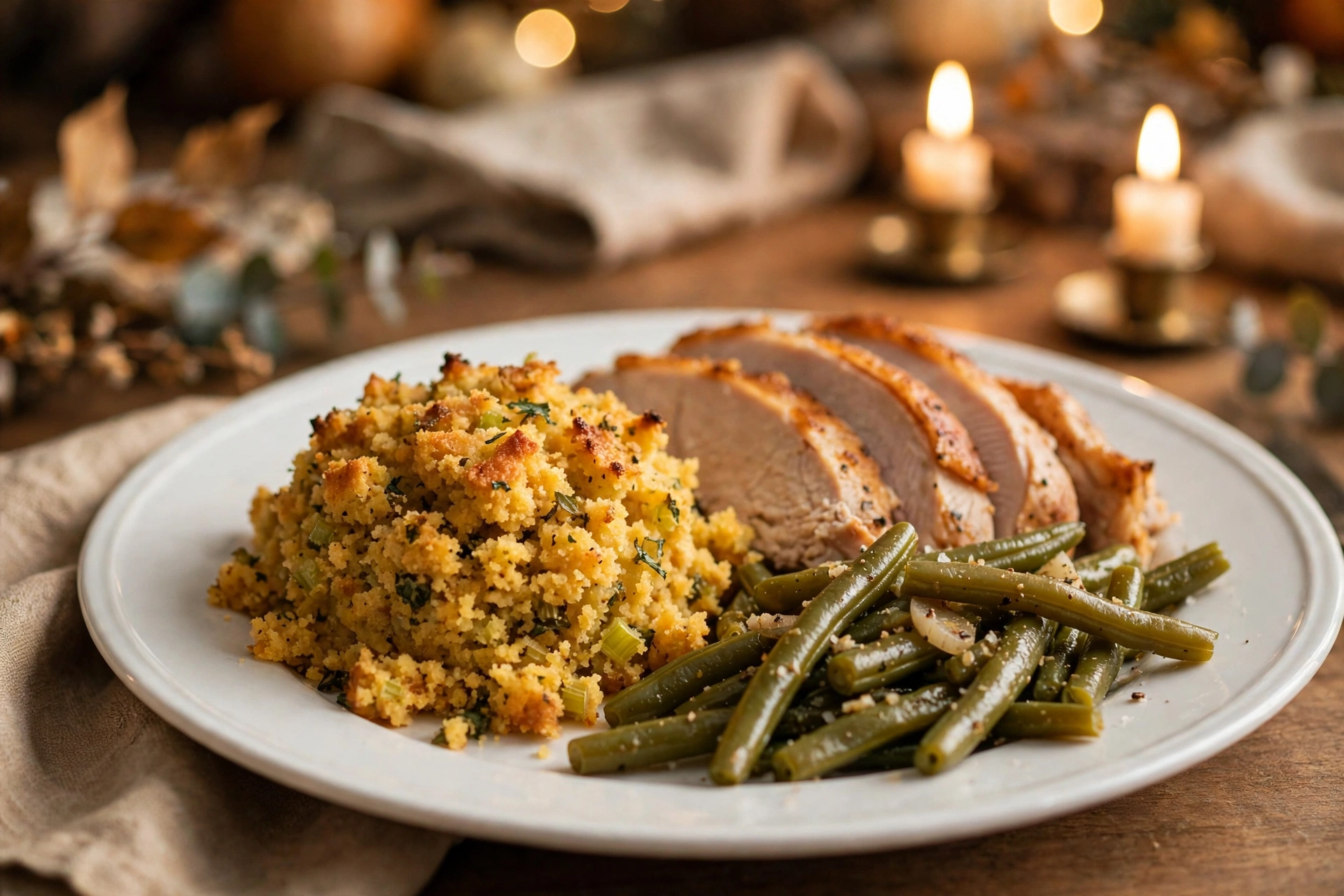
Cornbread stuffing sits at the center of the Thanksgiving plate, so build around it. Roast turkey and rich giblet gravy are the obvious partners — spoon the gravy right over the stuffing and let it soak in. Creamy mashed potatoes, green bean casserole, and candied sweet potatoes round out the classic spread.
For contrast, add something bright and acidic. A cranberry sauce with orange zest cuts through the richness. A simple salad of bitter greens with a sharp vinaigrette keeps the meal from feeling too heavy. And warm, flaky biscuits or dinner rolls give everyone something to mop up with.
Drinks-wise, a crisp hard cider or a lightly oaked Chardonnay both flatter the savory herbs. For a crowd-pleasing non-alcoholic option, sparkling cider with a splash of cranberry juice looks festive in the glass and tastes like the holidays.
Cornbread Stuffing FAQs
Can you make cornbread stuffing ahead of time?
Yes. Bake the cornbread up to 2 days ahead and store the dried cubes at room temperature. You can also fully assemble the unbaked stuffing a day ahead, refrigerate it covered, and bake it on Thanksgiving Day with 10 extra minutes of covered baking time.
Should stuffing be baked inside the turkey?
Food safety experts recommend baking it separately as dressing. Stuffing cooked inside the bird must reach 165°F in the center, which often means overcooking the turkey. Baking it in a dish gives you better texture anyway — more crispy top per serving.
Why is my cornbread stuffing mushy?
Too much broth or under-dried cornbread are the usual culprits. Dry your cubes thoroughly, add broth gradually, and remember the mixture should look moist, not swimming. Baking covered first and uncovered last also helps set the structure.
Why is my cornbread stuffing dry?
Not enough broth, or it baked too long uncovered. Next time, add broth until the mixture looks thoroughly damp with a little liquid pooling at the bottom. When reheating, always add a splash of broth and cover with foil.
Can you make cornbread stuffing without sausage?
Absolutely. Leave the sausage out and add browned mushrooms, extra butter, and vegetable broth to keep it savory. The vegetarian variation above gives you exact amounts.
What is the difference between stuffing and dressing?
Technically, stuffing is cooked inside the bird and dressing is baked in a separate dish. In the South, “dressing” is the standard word for the dish no matter how it is cooked. The terms are used interchangeably in most recipes today.
Can you freeze cornbread stuffing?
Yes, it freezes well for up to 3 months. Cool it completely, pack into airtight freezer containers, and thaw overnight in the fridge before reheating. Reheat covered with a splash of broth to restore moisture.
How much stuffing do you need per person?
Plan on about 3/4 cup per person as a side dish. This recipe fills a 9×13 dish and serves 10 to 12 as a side. If your crowd loves stuffing — and they will — consider making a double batch.
Can you use store-bought cornbread?
You can, but choose wisely. Pick a savory bakery cornbread, not a sweet cake-like mix. Dry the cubes well before using, since store-bought cornbread is often softer than homemade. Taste and adjust the salt, since commercial cornbread varies.
What herbs go best in cornbread stuffing?
Sage is the signature herb — it defines the classic Thanksgiving flavor. Thyme and parsley support it, and rosemary works in small amounts. Use fresh herbs when you can; they taste brighter. If using dried, use one-third the amount.
Final Thoughts
Great cornbread stuffing is not complicated, but it is deliberate. Dry the cornbread. Brown the sausage hard. Soften the vegetables fully. Season in layers. Give it both a covered steam and an uncovered crisp. Each step is small, and together they build a dish that tastes like the holidays are supposed to taste.
This is the recipe that will have people asking for the crispy corner pieces and spooning up seconds. Make the cornbread ahead, keep the method close, and do not be surprised when the stuffing outshines the turkey. In my house, it does every year.
If you’re planning the full holiday spread, this cornbread stuffing pairs beautifully with a juicy crockpot turkey breast that frees up your oven, and don’t forget a basket of warm salted honey butter Parker House rolls to round out the table.